

What Type Of Lithosphere Makeup Tectonic Plates
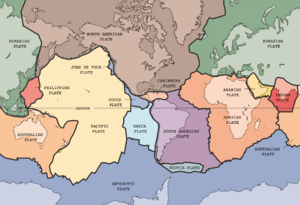
The tectonic plates of the Earth's lithosphere.
The lithosphere (from the Greek for "rocky" sphere) is the solid, outermost shell of a rocky planet. In the case of the Earth, the lithosphere includes the chaff and the upper layer of the mantle that is joined to the chaff. The lithosphere contains a rich variety of minerals. In add-on, it continually interacts with the atmosphere and hydrosphere.
Contents
- 1 Plate tectonics
- 2 Ii types of lithosphere
- two.1 Composition of oceanic crust
- 2.2 Composition of continental chaff
- 3 Run across also
- four References
- five External links
- 6 Credits
The World's lithosphere provides united states of america with the "terra firma" on which we alive. To sustain our lives, nosotros need access to air, water, soil, and sunlight, and nosotros need the ecosystems created by plants and animals. The lithosphere gives us access to all of these simultaneously. While dwelling house on the lithosphere, we are surrounded by air, receive the Lord's day's heat and light, and take admission to freshwater and various minerals that we use for our domestic, agricultural, and industrial activities.
Plate tectonics
In forming the lithosphere, the Globe's chaff and upper curtain are fastened to each other, but they differ in chemical composition. The purlieus that marks this change in chemical composition is known as the Mohorovičić discontinuity (or the Moho aperture).
Thus the distinguishing characteristic of the lithosphere is not its composition but its flow properties. It floats on the asthenosphere, which is the heat-softened layer of the mantle beneath the lithosphere. The lithosphere is fragmented into relatively potent pieces chosen tectonic plates, which move independently relative to ane some other. This motility of lithospheric plates over the asthenosphere is described every bit plate tectonics.
| | Continental / Continental | |
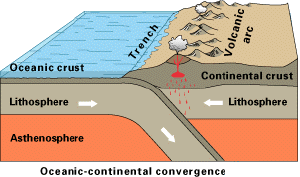
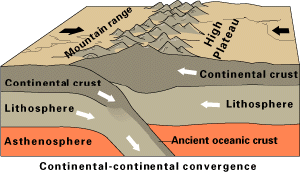
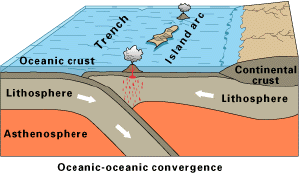
Ii types of lithosphere
There are two types of lithosphere: the oceanic lithosphere, or oceanic crust, and the continental lithosphere, or continental crust. The oceanic chaff is the office of Earth'south lithosphere that surfaces in the ocean basins. The continental crust is the layer of rocks that form the continents and areas of shallow seabed close to their shores, known equally continental shelves. The ii types of crust differ in composition, density, and thickness. As a whole, the oceanic crust is thinner but denser than the continental crust.
The oceanic crust is by and large less than 10 kilometers (km) thick, and its mean density is about 3.iii grams per cubic centimeter (g/cmiii). The thickness of the continental chaff ranges from 20 to 80 km, and its density is less than 3 one thousand/cm3.
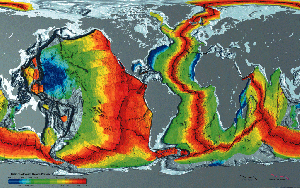
The oceanic crust. The increase in estimated age of the material is indicated by a progression of colors, from red to yellow to greenish to blueish. Nighttime red represents newly formed fabric; night blue represents crust that is 180 million years old. (Nighttime grey areas stand for landmasses; calorie-free gray areas point sediment-covered continental shelves.)
Every bit a consequence of the density difference, when active margins of continental crust meet oceanic crust in regions known as subduction zones, the oceanic chaff typically sinks beneath the continental crust and is recycled back into the pall. At the same time, new oceanic crust is continually being produced at mid-sea ridges from drape material. In addition, every bit the oceanic lithosphere grows older, it gets libation and denser, with the result that if two oceanic plates converge, the older one will subduct below the younger one. As a effect of these processes, most of the present-solar day oceanic chaff is less than 200 million years old.
Past contrast, the continental crust is rarely subducted or recycled back into the mantle. For this reason, the oldest rocks on Earth are within the stable "cratons" of the continents, rather than in repeatedly recycled oceanic chaff. (A craton is a stable part of the continental crust that has survived continental merging and splitting for 500 one thousand thousand years or more.) The oldest continental rock is the Acasta Gneiss, with an estimated age of 4.01 billion (4.01x10⁹) years.
Composition of oceanic crust
The oceanic crust is composed mainly of mafic rocks. The term mafic is practical to silicate minerals and rocks that have high concentrations of relatively heavy elements, particularly magnesium and iron. The word "mafic" is derived by combining messages from magnesium and ferrum, the Latin give-and-take for atomic number 26 [1].
Mafic minerals are unremarkably nighttime in color. Common rock-forming mafic minerals include olivine, pyroxene, amphibole, biotite and other micas, augite and calcium-rich plagioclase feldspars. Common mafic rocks include basalt and gabbro.
Composition of continental crust
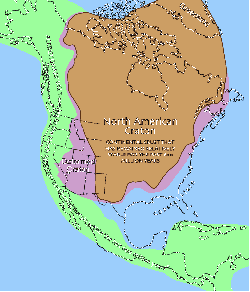
The N American craton.
The continental crust consists predominantly of felsic rocks. The term felsic is used in referring to silicate minerals, magmas, and rocks that are enriched in silica and light elements such as oxygen, aluminium, sodium, and potassium. The word "felsic" combines messages from the words feldspar and silica. Felsic minerals are unremarkably light in colour. Common felsic minerals include quartz, biotite, muscovite, hornblende, orthoclase, and sodium-rich plagioclase feldspars. The almost common felsic rock is granite.
It is a affair of debate whether the amount of continental crust has been increasing, decreasing, or remaining constant over geological time. 1 model suggests that prior to 3.7 billion years ago, the continental crust constituted less than 10 pct of the nowadays amount. By 3.0 billion years ago, that figure rose to nearly 25 per centum, and by about 2.six billion years ago, information technology was about 60 percent of the current amount (Taylor and McLennan 1995). The growth of continental chaff is thought to accept occurred in "spurts" of activity, respective to five episodes of increased product through geologic time (see graphic at Butler).
See also
- Asthenosphere
- Earth
- Earth's atmosphere
- Biosphere
- Cryosphere
- Hydrosphere
- Plate tectonics
References
ISBN links support NWE through referral fees
- Butler, Rob. Making new continents. http://earth.leeds.ac.great britain/assyntgeology/extra_info/ehistory.htm Accessed 01/29/2006
- Earth'due south Chaff, Lithosphere and Asthenosphere
- Crust and Lithosphere
- Stanley Chernicoff and Donna Whitney. Geology. An Introduction to Physical Geology, fourth ed., Pearson 2007
- Saal, A.50., Rudnick R.L., Ravizza G.East. & Hart S.R. 1998. Re-Os isotope evidence for the composition, formation and age of the lower crust. Nature 39317, 1998.
- Taylor and McLennan. 1995. Model of growth of continental crust through time in John Victor Walther 2005, Essentials Of Geochemistry. ones & Bartlett. ISBN 0763726427
- von Huene, R. and D.Due west. Scholl, 1991. "Observations at convergent margins concerning sediment subduction, subduction erosion, and the growth of continental chaff." Reviews of Geophysics 29: 279-316.
External links
All links retrieved July 24, 2018.
- Limerick of Continental Crust
Credits
New World Encyclopedia writers and editors rewrote and completed the Wikipedia commodity in accordance with New Earth Encyclopedia standards. This commodity abides past terms of the Artistic Eatables CC-past-sa 3.0 License (CC-by-sa), which may be used and disseminated with proper attribution. Credit is due under the terms of this license that can reference both the New World Encyclopedia contributors and the selfless volunteer contributors of the Wikimedia Foundation. To cite this article click here for a listing of adequate citing formats.The history of earlier contributions by wikipedians is accessible to researchers hither:
- Lithosphere history
- Oceanic_crust history
- Continental_crust history
- Felsic history
- Mafic history
The history of this article since it was imported to New World Encyclopedia:
- History of "Lithosphere"
Note: Some restrictions may apply to use of individual images which are separately licensed.
Source: https://www.newworldencyclopedia.org/entry/Lithosphere
Posted by: martinlivelyins.blogspot.com
0 Response to "What Type Of Lithosphere Makeup Tectonic Plates"
Post a Comment