

Which Of The Following Did Not Help Makeup The Democratic Party During The Gilded Age
How to Tell the History of the Democrats
How to Tell the History of the Democrats
What connection does the party of Thomas Jefferson and Andrew Jackson have to the party of Barack Obama and Kamala Harris?
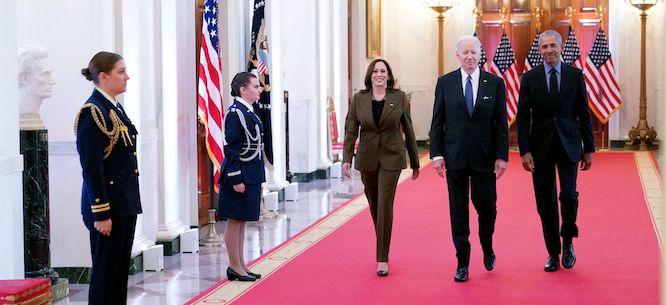
Booked is a series of interviews about new books. For this edition, Dissent co-editor Timothy Shenk talks to editor emeritus Michael Kazin, the writer of What It Took to Win: A History of the Democratic Party (FSG).
Democrats belong to the oldest mass political party in the world. But what connection does the party of Thomas Jefferson and Andrew Jackson have to the party of Barack Obama and Kamala Harris? Michael Kazin explores this question in his latest book, What It Took to Win. We spoke about the party'southward evolving ambitions, its human relationship with the left, and the historical origins of the predicaments facing Democrats—and the residue of united states of america—today.
Timothy Shenk: Let's get-go with a question that I couldn't help thinking about while I was reading: do Democrats today even want to know near their own history? They used to exist very proudly the political party of Jefferson and Jackson, and now they very much are not.
Michael Kazin: Well, they don't hold Jefferson-Jackson fundraising dinners anymore. I think they do believe that they're the party of working people—or at least that they should be. I recollect that's true across the spectrum; information technology's true for both Joe Manchin and AOC. They feel like their merits to power is, "We represent the bang-up bulk of people."
Shenk: With that in mind, it seems like there are two swivel moments in the making of the modern Democratic Political party. One takes place in the 1930s, when Democrats became the party of organized labor; the other takes identify in the 1960s, when they became the party of civil rights.
Kazin: Don't forget almost the 1890s. Before then, Democrats wanted a weak federal state, partly because the Southern wing didn't want the federal authorities to practise annihilation about slavery and, later, Jim Crow. But in the 1890s, the farmer-labor movement of the Gilded Historic period actually fabricated an impression on the Democrats as a whole. Part of that is considering the Democratic machines signed upward immigrants, who came in in large numbers and needed a lot from the regime because they were not getting more than a modest wage from their employers. William Jennings Bryan's campaigns, especially the get-go one in 1896, moved the political party at least rhetorically toward favoring a stronger federal state in lodge to assistance small farmers and workers—albeit but white ones. It was the height of the party'southward anti-monopoly history.
Shenk: Do you recollect it was more than or less inevitable that organized labor would sync up with the Democratic Party in the mode that information technology did in the 1930s? Was at that place ever a world where organized labor splits betwixt the 2 and lines up with Republicans?
Kazin: Well, it was divide between the two before the 1930s. For instance, John Fifty. Lewis—the head of the United Mine Workers—had been a Republican. The Depression changed everything. At that place were all these pissed-off industrial workers of dissimilar ethnic backgrounds who felt like the system was non working for them anymore. This was afterwards it worked pretty well for a lot of them in the 1920s, when wages were going upward, in that location was some profit sharing, and there were some company unions that weren't always terrible. But that all complanate. Without the Low, who knows what would have happened?
Shenk: If the attempt to electrocute FDR in 1933 had succeeded, making John Nance Garner president, it's difficult to encounter the Democrats condign the party of organized labor.
Kazin: Contingency really matters. History is not simply nearly structural alter.
Shenk: So it's non an blow that Democrats became the party of organized labor, but it probably wasn't inevitable. Which might exist why even though Democrats accept a long history of seeing themselves as the political party of the working class, there's an equally long history of many working-grade voters saying, "Actually, no, we like these other people more."
Kazin: If economic policy and economic visions are key to why yous win and why you lose in American politics—and I think they normally have been—and then y'all'd look working-grade people to look to their interests. And a high tariff was in your interest during the tardily nineteenth and early on twentieth centuries if you were a steel worker in Indiana, Illinois, Pennsylvania, or Ohio. During that catamenia, some white workers in the North voted Republican because the Southward was the heart of the Autonomous Party. They knew that for almost white workers, too as nearly all Black workers, wages in that region were low and living standards were poor.
Shenk: What about the civil rights turn in the 1960s? Was it as rooted in the party's history as its marriage with organized labor in the 1930s, or was it more than of a surprise?
Kazin: It was a huge turnaround. I contend in the book that the CIO had a lot to practise with the party'southward turn to civil rights. It's not that suddenly FDR was some great racial egalitarian—he wasn't. He needed to get the mine workers on his side, as well as the car workers and the steel workers, and all of those unions were interracial, because Black people worked in those places and socialists and communists were involved in organizing those unions. In 1936, the United Mine Workers was the single-largest correspondent to the Autonomous Party.
Liberal intellectuals fabricated a difference as well. They had been brought up disliking the Democratic Political party every bit a breastwork of racists and corrupt machines. Only the anti-fascist stance of FDR and the emerging racial pluralism of the party during the 1930s turned most artists and writers into Democrats.
A growing number of feminists became Democrats, besides, beginning in the 1920s. Few prominent white women in the party took a articulate correspond civil rights, just they were mostly from New York, and they were used to working with Black people, and then it was more than difficult for them to represent a policy of not alienating the white South. Eleanor Roosevelt, who was role of that group, tried to push her husband to have a more forthright stand up for civil rights. He didn't do information technology. The New Deal coalition only fabricated a few gestures at anti-racism but didn't actually brand the transition until the 1960s.
In 1938, Roosevelt did back primary campaigns against Dixiecrats, but the candidates he supported failed in almost every case. Still, Democrats could see that he was trying to modify the party to make it more pro-labor and more friendly to Black voters, a majority of whom voted for the Democrats in 1936 for the beginning time in history.
Shenk: When I teach the making of the New Bargain coalition, it's difficult to come up with practiced primary sources because there was no one saying, "Here'south how nosotros should remake the Democratic Party: let's put the KKK and Black Communists together." It was such a strange brotherhood, and every bit far as I know basically nobody saw it coming ahead of time. So I end up using a memo that two Democratic operatives wrote for Harry Truman in the run-up to the 1948 campaign explaining how he could put FDR's majority dorsum together. It describes the Autonomous Party of 1948 equally a party of the South and the West united by their hatred of Wall Street. They argue it had been that way from Jefferson to Jackson to Bryan to FDR, and information technology was the only way to hold the Democratic coalition together.
What'southward striking to me about this interpretation is that information technology doesn't at all fit with the story you would get if y'all merely took today's red-blue map and projected it backward. They're not saying that a progressive wing of the party in the Northeast has to deal with a bunch of reactionaries in the South and West. They're saying that at that place's a autonomous—or maybe just populist—tradition that Democrats must tap into if they desire to win.
Kazin: All political historians accept to accept seriously the fact that we've got only 2 major parties in a big, complicated country. Both are fabricated up of coalitions of people who in other countries would exist in different parties. For that reason, yous have to find the lowest common denominator, which sometimes is almost impossible to exercise. It was impossible in the 1890s, so the party split up. Information technology was impossible again in the 1920s, when at that place were proto–New Dealers like Frances Perkins and Eleanor Roosevelt and so there were people like [New York Governor and 1928 Autonomous presidential nominee] Al Smith, who became bitter near how the party changed.
Shenk: I am persuaded that there's a potent case for seeing the Democratic Party's lineage every bit the political party of working men. Only if I were going to write a usable past for the Democratic Party equally information technology is today, I think y'all could portray them as a political party of herrenvolk multifariousness in the nineteenth century that grew into the multiracial coalition we have today. They were the political party that said "alive and allow live" on slavery in the antebellum period, and the party that welcomed Catholics and other European immigrants into their coalition—basically, the party that said white men were stronger together. And you come across a variation of this downward to the 1950s, when Adlai Stevenson has to explain why Northern liberals should make common cause with Jim Crow and says that Democrats are "the party of everyone."
This strain inside the party was used to defending what strikes us today every bit a warped kind of diversity. In the postwar years, a new generation came along that used this emphasis on variety for very different purposes. But you could argue that in that location's been a long-running debate in the party: are we the party of the ordinary working stiff, or are we "the party of anybody"?
Kazin: That all-white form of diversity is hardly 1 Democrats today would salute. Only Democrats used to say, even in the 1920s, "We're the only national political party. Republicans are a sectoral party, just as they were in the 1870s." And if it weren't for Vietnam in 1968 and and so the economic woes of the 1970s, Democrats might've been able to keep the New Deal coalition going.
Shenk: So y'all think Vietnam really was the crucible of the New Deal order?
Kazin: Sure. Alongside the oil crisis of 1973 and stagflation. Most Americans didn't know who Keynes was, simply they knew that the government was supposed to be keeping the economy stable, and it didn't exercise that.
Shenk: Only if you wanted to brand the case that reactionaries broke the New Deal coalition, you would say that it was really 1968 when the wheels came off the autobus.
Kazin: Simply they came back on the omnibus. Jimmy Carter got elected in 1976, if barely.
Shenk: With a lot of support from the South.
Kazin: Of course. But he was a terrible politician. He didn't keep labor on his side. He had no idea how to talk about a better economic system in a way that didn't seem like he was berating people (in his gentle style, but yet). He was facing serious problems that he didn't create. That's true for every president, but he had no mode to exit of them. At the aforementioned time, the labor movement was declining, and the New Bargain coalition was dividing over things like busing. Information technology's non as if he could've kept the whole thing together just by supporting labor constabulary reform and backing a strong version of the Humphrey-Hawkins full-employment pecker. He should've done those things, but that was not going to solve the trouble.
Shenk: That's what's so frustrating about looking at these debates from the 1960s and '70s with the do good of hindsight. Yous run into that Republicans were drastic to put together a bulk, and as well many Democrats and liberals and leftists of various stripes took theirs for granted. And we've been living with the consequences.
Kazin: I concur. The 1968 Democratic Party platform was basically a pattern for a social democracy: housing and healthcare for everybody. Just Humphrey didn't even talk well-nigh information technology, because all he could exercise was defend the war, which was all that people cared about. I wish I'd voted for Humphrey. I wasn't old enough to vote yet. Merely we New Leftists should take put our disgust for the state of war-making Democrats bated long enough to keep Richard Nixon out of the White House.
Shenk: Yous could fence that the stakes are lower today, simply a similar dynamic is going on in progressive circles. At that place are moral causes including racial justice and clearing, and if y'all can't get a majority behind them reliably, well, then much the worse for the bulk.
Kazin: If Donald Trump didn't teach you that Democrats, as bad equally they sometimes are, are meliorate than the Republicans, I don't know what volition. But I don't call back the problems that progressives and moderates in the party fence about should be deal-breakers the manner the Vietnam State of war was. Three and a half meg people died in that state of war. Nothing Democrats are doing is remotely like that. If Joe Biden were to practice to a country what Putin is doing to Ukraine, then I could non back up the Democrats, if they were supporting him. The political party would be split.
What Trump did has not divide his political party, at least plenty, even after January 6. The trouble for leftists, and this has always been a problem, is that you have to build your movement based on moral appeals and serious decision to push sure issues forward, just yous also have to form alliances whenever possible with a governing party, or else you're not going to turn your desires into constabulary. And you have to build institutions to be able to do that. It'due south a matter of strategy. The Democratic Party is the only party that will invite progressives into its fold and even maybe practice annihilation that progressives want done—if progressives button them in a smart way.
Shenk: You've written a history of the Democratic Party, and you lot've too written a history of the American left. One way that you've tried to reconcile the tension betwixt those two groups is to say that the fortunes of the left are linked to the Autonomous Party. The Great Society, the New Deal—those are significant moments not just for the Democrats but for the left. Even if both sides take disagreements in theory, when y'all win, it's improve for everyone.
Kazin: You put it very well.
Shenk: But it doesn't experience that mode right now. Democrats have command over two of the branches of government—the narrowest possible control, just still, command—and it's coincided with what feels like a backlash that'due south taken some of the current of air out of left movements that flourished in the Trump years. In retrospect, 2020 looks similar a victory that set up both Democrats and the left up for some big disappointments.
Kazin: If you win narrow majorities, you're not going to achieve big things. That's just a truism of politics. It was foolish for Democrats, whether progressive or otherwise, to believe that somehow Manchin or Sinema were going to be for this broad agenda—catastrophe the filibuster and everything else. Nobody expected Democrats to control the Senate in the first place. You accept to set up the footing for later victories. Leftists did that, I would argue, in the early twentieth century and the 1890s, to some degree; they did it in the 1920s and even the 1950s, when the Blackness freedom movement really got going in a major fashion. To me, the best thing that happened on the left—starting time with Bernie in 2016—is that leftists ran as Democrats. The tertiary party delusion was for the about part thrown away. That was true in the '30s, too.
Shenk: Like the Minnesota Farmer-Labor Party.
Kazin: There were two Communist congressmen in the '30s, even though they didn't acknowledge they were members.
Republicans are almost certainly going to win back the House and probably the Senate, the way things await now. So what do progressives do about that? What do leftists practise? Do they say, "Nosotros tried, forget most information technology," or do they say, "It'southward hard to win majorities. How practice we practise that?"
The key is to help working-class people build institutions—beyond racial lines, across immigrant and native-built-in lines, like the Culinary Workers Local 226 in Nevada did.
I f y'all don't practise that, the most progressive politicians in the world are only going to be able to accomplish so much. If we believe in democracy, people have to organize themselves to make demands. Without the CIO and the AFL, without the Townsend Plan [for Social Security], without [populist Louisiana Governor and Senator] Huey Long even, the New Deal would not have been the New Deal. You've got to build movements, and you've got to exist function of a major party.
Shenk: With institutions every bit the middle footing between the ii. It feels like there are Democrats on one side, there's populism on the other, and what we're missing is those institutions that can be a span.
Kazin: Social media—which is an institution, just not the kind of establishment where you go to build trust with people—makes it hard.
Shenk: You lot detect your tribe. Yous don't expand it.
Kazin: People don't feel they have to talk to one some other. Considering it'south all about mobilization. That'due south a big fence in the Democratic Party, mobilization vs. persuasion, and conspicuously, to me, the answer is both. You persuade equally long as you tin, then when ballot comes near, yous have to mobilize. Y'all can't practise one or the other, because you don't win that way.
Michael Kazin is editor emeritus of Dissent and the writer of What It Took to Win: A History of the Democratic Party (FSG).
Timothy Shenk is co-editor of Dissent.
Source: https://www.dissentmagazine.org/online_articles/how-to-tell-the-history-of-the-democrats
Posted by: martinlivelyins.blogspot.com
0 Response to "Which Of The Following Did Not Help Makeup The Democratic Party During The Gilded Age"
Post a Comment